
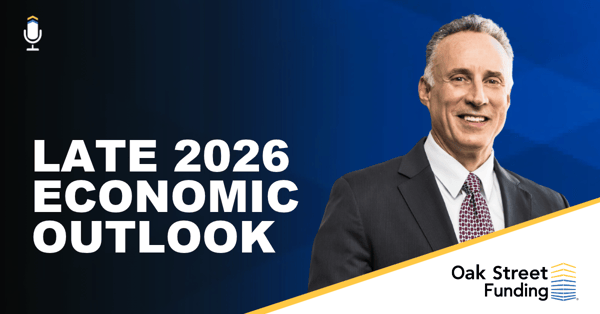
Challenges lie ahead, but growth is still likely to continue. That’s the message Marc Chandler, Managing Director and Chief Market Strategist at Bannockburn Capital Markets, shared on a recent Oak Street Funding OnPoint podcast. What are the challenges; what’s driving them, and what can businesses expect as 2026 winds down?
• 33 min
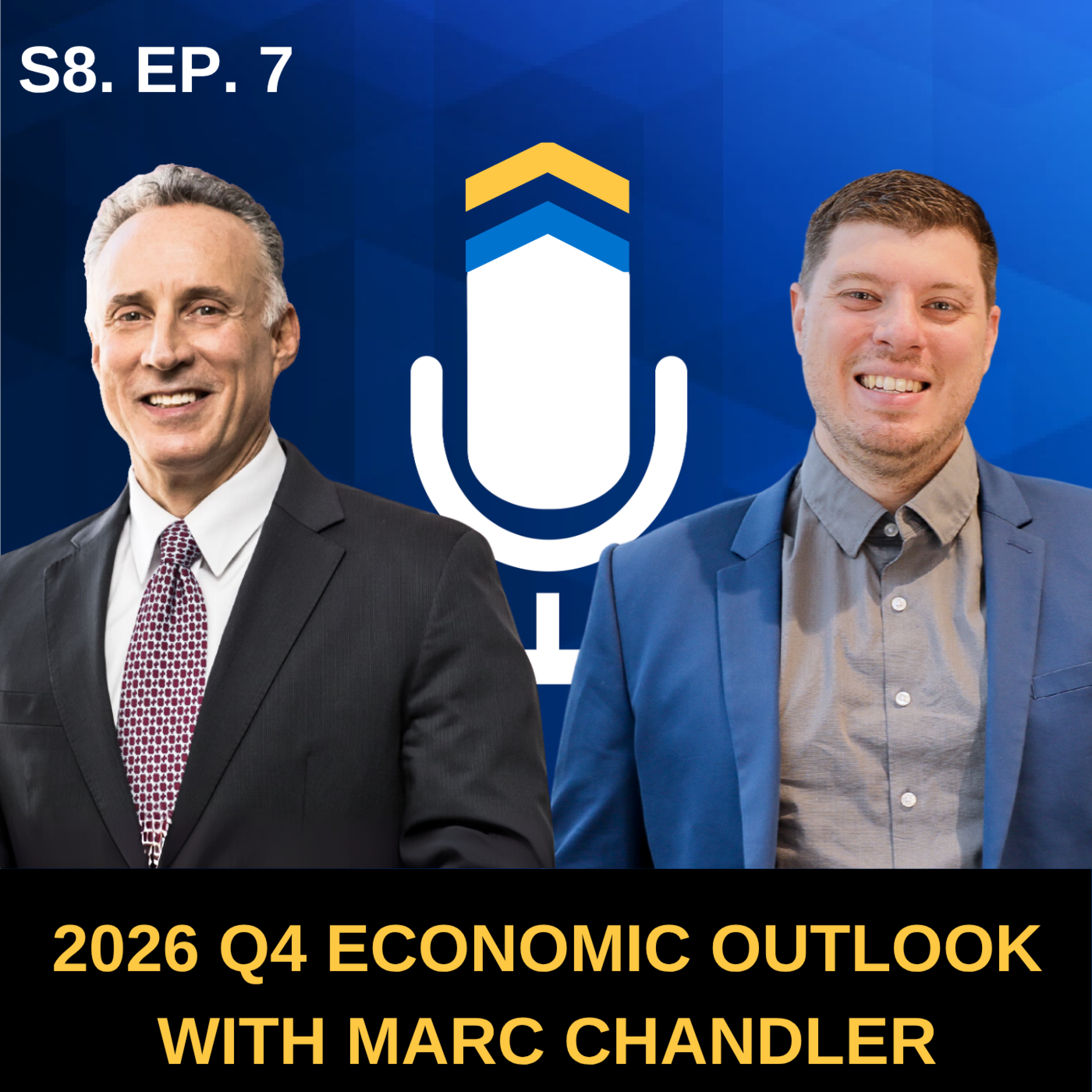
S8 EP.7 - 2026 Q4 Economic Outlook: Rates, Risks, and the Road Ahead with Marc Chandler
OnPoint with Oak Street Funding
Play
Overall outlook
GDP has slowed in the last couple of quarters, but Chandler believes a better metric to follow is Real Sales to Final Domestic Purchasers (RSFDP). That measure has been accelerating since the fourth quarter of 2025.
Recent ups and downs in the jobs report (decreases in July and increases in August) along with changeable unemployment numbers suggest that the jobs market is still somewhat unpredictable.
These conflicting signs are causing unease, but that uncertainty is offset by two factors. First, consumers are still buying (sometimes dipping into savings to do so) and second, investments in AI (technology, construction, and many related industries feeding into the AI buildout) are driving economic growth.
Major issues driving economic uncertainty
Chandler sees the war with Iran and the El Niño weather pattern as major issues behind this uncertainty. The closure of the Strait of Hormuz has driven up energy prices, which impact every area of the economy. Markets have grown skeptical of reports that the Strait will open soon, and investors are not expecting any imminent drop in energy prices.
The El Niño weather pattern, which is causing drought and record heat waves across the globe, is combining with shortages in fertilizer (20-30% of which came through the Strait of Hormuz prior to the war) to drive up food prices. In addition, the weather is associated with drops in river levels, necessitating the use of smaller ships for transport, putting further upward pressure on food prices.
Changes at the Fed
Chandler pointed out that under the three previous Federal Reserve chairs – Ben Bernanke, Janet Yellen, and Jerome Powell – the Fed followed a trend of increasing transparency that central banks across the world have adopted. It was usually fairly evident which way the Fed was leaning with respect to rate changes. With new chairman Kevin Warsh, Chandler senses that communications are less clear.
Chandler described the Fed’s talk-but-no-action approach to raising rates in the months before the September meeting as being behind the steepening of the U.S. yield curve. The yield curve change demonstrated the market’s lack of confidence that the Fed would act quickly and aggressively enough to tame inflation. It remains to be seen how the Fed’s unanimous vote to raise the Federal Funds target rate by a quarter of a percent at the September meeting will affect yields.
Predictions for GDP growth, unemployment, and inflation
Trend growth is around 1.7%, so it appears that the U.S. economy is growing a bit above trend. According to Chandler, that’s good for businesses, but it also makes it harder to get prices under control.
Chandler expects unemployment to tick up a bit in the coming months. He noted that the weekly jobless claims for first-time filers report provides a more accurate picture of the jobs market than does the overall unemployment rate.
With respect to inflation, Chandler foresees little progress this year. Energy prices continue to stay elevated while the war in Iran continues, and food prices are likely to stay firm, given high energy costs and extremes in weather conditions. He also said to expect more tariffs.
Biggest economic risks ahead
Chandler identified tariffs and the war in Iran as the two biggest risks ahead. Even though many of the administration’s initial tariffs were ruled unconstitutional and are being refunded, Chandler expects that more are on the way. Because they contribute to reducing the deficit, he thinks future presidents will be unlikely to do away with them.
The continuing war in Iran is disruptive not only for oil prices, but for other things that come from oil, including natural gas, pesticides, fertilizer, and some materials used for semiconductor manufacturing. “The shock of higher oil prices, higher energy prices, and tariffs keeps our U.S. clients in a very uneasy situation - unbalanced and unsure about the broad direction,” noted Chandler.
Finding your way
To find your way in this challenging market, Chandler recommended tracking two key data points to follow the economy in real time: the jobs market and inflation.
He also recommended working with trusted advisors. As he put it, “For a lot of our clients, and even ourselves, we need trusted advisors that we can go to during times when things seem to be in turmoil or chaotic and there is a lot of uncertainty.”
Here at Oak Street Funding®, we welcome the opportunity to share our experience as we all work through this ever-changing economic period. Contact us today to learn more.
⚡At a Glance: Late 2026 Economic Outlook
- • Economic growth is likely to continue into late 2026, supported by consumer spending and AI-related investment, though mixed jobs data is creating uncertainty.
- • Inflation pressures remain elevated due to higher energy costs, food price increases, El Niño-related disruptions, and potential new tariffs.
- •
The war with Iran and closure of the Strait of Hormuz are major risks affecting oil, fertilizer, transportation, and supply chains.- •Businesses should monitor jobs data and inflation trends closely and work with trusted advisors to navigate market volatility.
Disclaimer: Please note, Oak Street Funding does not provide legal or tax advice. This blog is for informational purposes only. It is not a statement of fact or recommendation, does not constitute an offer for a loan, professional or legal or tax advice or legal opinion and should not be used as a substitute for obtaining valuation services or professional, legal or tax advice.